Hi Everyone,
Hope for Congo has relocated to a new URL.
You can now find us at www.hope4congo.com
We are pleased you want to follow us and welcome you to our new location.
Thank you for your support,
Brad Graber
Monday, January 12, 2015


Monday, March 25, 2013
2013 Hope for Congo Trip-Spring Water Project
 |
| Crossing the Kasai at Ndjoko Punda |
 |
| Welcome to Ndjoko Punda |


Stan Graber in person
 |
| Water Spring Workers |
I just returned from Congo and, first off, need to explain that my international data plan on my cell phone did not work there. To say the least, communication as I had planned was not possible. I bought a simple cell phone there and was able to use it to call home.
I traveled to Congo with Fred Suter and Les Schlegel who had served in Congo 45 or so years ago. Both men worked at Ndjoko Punda doing maintainance and agriculture related work.
God tells us to make our plans, but He directs our steps. This truth about God was clear as we moved ahead to provide clean water to the hospital at Ndjoko Punda.
Our purpose in going was also to encourage the believers there who depend on God daily just to survive and feed their families. To know others care enough to come and help solve problems encourages them and gives them hope.
The first day in Kinshasa, the Capitol city, was spent looking for the steel pipe we needed for the supply line from the spring to the ram pump. We had shipped a pump and some pipe and fittings but tried to limit the shipping weight to things we could not get in Congo because of high shipping cost.
A ram pump uses water to pump water. Because water is heavy, the ram, with only 2 moving parts, uses the energy of gravity to create a water hammer effect between 2 check valves that open and slam shut. This energy sends a small amount of water up the delivery pipe every time it cycles; one to two times per second. No electricity or other energy source is needed and it will run day and night as long as water flows thru the pump; very simple appropriate technology.
While in the Capitol I met with two Christian young men from Ndjoko who are being sponsored by Hope For Congo: Joseph, in mechanics training, and Daniel, in Theological school. They are doing well and plan to return to Ndjoko Punda when they finish. These young men are very bright and eager to learn. It was great to see them again and encourage them.
The pump and pipe and supplies we shipped from the states had arrived at the MAF (Missionary Aviation Fellowship) hangar ahead of us. A $2000 Congo customs fee had to be paid, however. A problem came up with the MAF Cessna Caravan we were to fly in to Ndjoko, so Garth Pederson, our pilot, had to shuttle us and our 800 lbs. of supplies, using a smaller aircraft. Each flight required a fuel stop at a station,Vanga, half way. My hat is off to the MAF staff and pilots like Garth who work so hard in difficult circumstances and sometimes impossible conditions to facilitate folks like us and other mission efforts. Our flight took us thru some heavy rain and absolutely zero visibility, but also over some beautiful country, rivers and streams.
 |
| Welcome to Ndjoko Punda |
Before we got to the river we were stopped by an immigration official who insisted on $50 from each of us. We were taken to his mud hut office on the river bank where he checked our passports, letters of invitation, etc.. The next day he showed up across the river to inform me that I had given him an outdated $100 bill. They want American dollars but they have to be in mint condition and dated post 2006. It is that way all over Congo. I don't know why.
 |
| Crossing the Kasai at Ndjoko Punda |
The family gave us their beds to sleep on while they slept on the cement floor, without mattresses. They have 9 children.
While we were there people brought gifts of pineapple, other fruit, peanuts, and eggs. We ate twice a day, usually fruit and peanuts in the morning, and bidia, meat, and greens in the evening.
We all loved the food but could never eat much because of the heat and fatigue. The Congolese are so gracious and kind and we were well cared for.
The work at the spring below the station had already begun before we arrived. The young men, some not so young too, but very tough, hard workers, had dug into the hillside into the spring and built a open-bottom concrete, 10 ft., square box; walls about 3 feet high, with some plastic pipes going back through the concrete walls into the dirt. The hillside had caved in and covered all this up so the entire first day was spent digging it out.
The Sunday morning worship was full: lots of great singing, a sermon in Tshiluba and Lingala, and an offering that lasted about 15 minutes. Two baskets in front are filled as folks sing and slowly dance their way to the front and give. Some come up more than once, and all participate. Towards the end of the service, about 2 1/2 hrs., pastor asked for volunteers to give food for us and the workers, and also carry gravel and sand down to the spring project.
I watched as the believers read from tattered and worn Bibles and song books so worn they are falling apart. We need to provide new Bibles and books. Some have been provided by Hope For Congo but many more are needed. Cost to print Bibles in their language is $9 each. We provide these at a cost to them of $3. You can donate to:
Hope For Congo
AIMM
PO Box 744
Goshen, IN 46527-0744
 |
| Water Spring Workers |
We enjoyed visiting on the porch in the dark each evening and early mornings. A little generator was used to give some light and charge cell phones, but most of the time it didn't work or they had no fuel.
A number of older folks who knew our parents or had worked with other missionaries would come with worn and tattered pictures to show us and ask why we have forgotten them. You could see they cherish these memories and photographs. These visits only reinforce our desire, with God's help, to do all we can to help our brothers and sisters here.
One evening some kids brought a young genet: looks like a mongoose, has spots like a leopard, rings on its tail like a raccoon, and a long nose. About the size of a cat. They kill snakes and make good pets. We were also offered a parrot, but there is no way we could take these home.
Les had worked here at Ndjoko with a helper, a young man named John. To Les' surprise, John in his 70's now, came to see him and invited us all to his house in the village for a meal. Wednesday evening we went there and had some great bidia and chicken. Other meals included goat, small deer, and fish from the Kasai river. Keep in mind we were treated very special and most people don't get meat often.
On Thursday, Garth flew out to pick me up to go back home. Les and Fred are staying till the 29th and will, with God's help, see water pumping to the hospital. We had purchased a 6500 KW diesel generator for the hospital while we were in Kinshasa, so Garth brought it with him. He removed the seats to bring it and had to take the airplane door off to get it in and out. 8 young men with long poles then carried the 450 lb. machine to the river and then up to the station.
I received a call today from Fred. The pump is in, the line is laid and plumbed into the tank, but fine sand is plugging the sand filter in the spring encasement. They will change the screen to something larger so the volume remains constant. Please pray for wisdom to solve this problem without plugging the pump or delivery line to the tank.
 |
| Glen & Rita Chapmen with Powerchute |
On my return flight to Kinshasa we stopped a Vanga for fuel and Garth told me we would make an unexpected stop at Kikongo. What a neat surprise as I knew that is where Glen and Rita are. In a short time we landed on the grass air strip right in front of their house! I felt as if God arranged this unplanned event just for me because He knew that for years I have wanted to meet Glen and Rita. Glen rolled his powered parachute out of the shed behind his house and we talked about flying for about 10 minutes. It was short, but what a blessing it was. Search "Glen Chapman" or "Congo Powered Parachute" on YouTube for some good video about this.
2 Thessalonians 1:12, "That the name of our Lord Jesus Christ may be glorified in you, and ye in Him, according to our God and The Lord Jesus Christ."
Stan
Thursday, March 14, 2013
Back in Kinshasa
Stan left Ndjoko Punda this morning via MAF (Mission Aviation Fellowship) plane for Kinshasa, leaving Fred Suter and Les Schlagel to wrap up the project.
Stan flies back to the United States tomorrow afternoon at 2:30 p.m. Kinshasa time.
The water project continues to move forward. God continues to supply in the absence of supplies. As all Congolese know, one must be a master at inovation and creativity if you are to be successful and God has given the guys the ability to do so.
There was a lot of enthusiasm and willing workers to assist with the project. A lot of work to date has been accomplished. School children were given two days off from classes to go and help with carrying supplies down to the spring in the forest.
Communication via cell phone while at Ndjoko Punda was problematic. Stan will have some updates and pictures to provide upon his return.
Continue to pray for the completion of the project and continued health and safety for Fred and Les.
Monday, March 11, 2013
Update-Ndjoko Punda Water Project
This is Bonnie and Abby writing on Stan's behalf. He is having trouble with his email, but wanted you to be updated on their progress.
After some difficult days accumulating the remaining needed supplies in Kinshasa , they arrived in Ndjoko Punda on Friday via MAF airplane. Since then they have done much planning, praying, coordinating, and have started the work of getting water to the village. They have cleared 150' between the spring and where the pump will be installed. They are happy with this progress. The most urgent need right now is for 2" pipe. Fred went back across the river trying to find some. Please pray for this. They have had a lot of willing and hard working helpers from the village.
They are staying in the same house that Stan lived in as a child. It is very hot. Last night's supper was bedia (cassava flour mush), matamba (cooked greens), dikdik meat, and bananas. The time difference is seven hours ahead of us.
There have been many God-appointed circumstances which I'm sure Stan will write more about later. Please keep praying for them. The needs are great but God is sovereign!
God bless you all for your care and concern!
--
Sunday, March 10, 2013
Safe Arrival
Received a short text from Stan today. Hope for Congo team were successful in getting their supplies flown in to Ndjoko Punda. Today was spent at church and in planning for the work that will begin on Monday.
Life at Ndjoko Punda is 7 hours ahead of central standard time here in the United States.
Life at Ndjoko Punda is 7 hours ahead of central standard time here in the United States.
Water-Key Facts
1.8 million children die every year as a result of diseases caused by unclean water and poor sanitation. This amounts to around 5,000 deaths a day. (UNDP)
At any one time, half the population of the developing world is suffering from one or more of the main diseases associated with inadequate provision of water and sanitation. (UNDP)
While the average North American uses 400 liters a day of water, the average person in the developing world uses 10 liters of water every day. (WSSCC)
Households in rural Africa spend an average of 26% of their time fetching water, and it is generally women and children who are burdened with the task. (DFID)

Wednesday, March 6, 2013
DHL Shipment

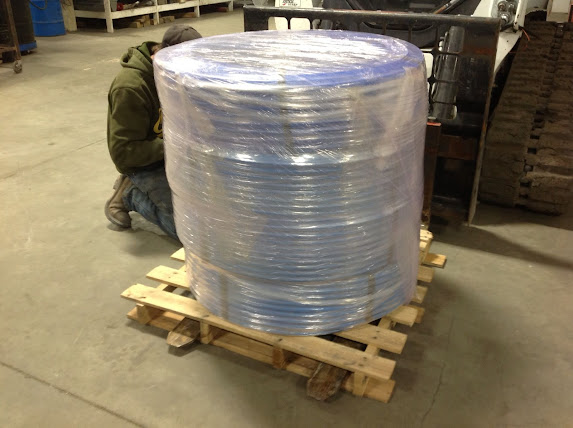 DHL shipment sent from Wichita Kansas included 2000 feet of pipe, ram pump, pipe fittings and miscelaneious supplies to finish water project at Ndjoko Punda. Pray that we can get it through customs without additional monies.
Stan Graber will be going with two friends, Fred Suter and Les Schlagal, who have also
worked and served in the Congo, to Ndjoko Punda DRC leaving Tuesday March 5th.
Stan says, "The main reason for this trip is to install a hydraulic ram pump at a spring near the village of Ndjoko Punda where I grew up. This project includes laying 1500 feet of pipe and installing a storage tank at the mission hospital where there is currently no running water. This project has been in the works for three + years. Because we could not get quality material there we had to ship the pump, pipe, and parts from here even though it was very expensive. We will also be checking on the generator there which some of you helped pay for. It is unclear at this time how it is working. Keep in mind communication and logistics is a huge problem and a matter of concern for anyone praying about these projects."
Watch for additional post over the next two weeks.
Monday, February 4, 2013
Plans are under way to finish up the water project at Ndjoko Punda. We have been delayed by lack of quality supplies available in Congo for this project. The decision has been made to purchase necessary waterline piping supplies and a ram pump here in the states.
Supplies will be sent DHL to Kinshasa within the next week. From there we will fly the supplies into Ndjoko Punda via MAF.
Stan Graber, Fred Suter and Les Schlegel will be leaving March 4, 2013 for the DRC. We have been encouraged by the contacts and networking that has materialized while we have waited for the details to come together. We make our plans, God directs our steps.
Pray that God will grant Stan, Fred and Les safety and success in completing this long awaited effort.
Pics to follow.
Wednesday, August 22, 2012
Congolese celebrate century of God’s faithfulness
By Lynda Hollinger-Janzen Mennonite Mission Network
Page:
- 1
- 2
TSHIKAPA, Congo — About 50 young musicians walked nearly 100 miles carrying their drums, luggage and a few babies to attend the centennial celebration of Communauté Mennonite au Congo (CMCO, Mennonite Community in Congo) July 16-22.

For a week, the choir members from Ndjoko Punda, one of the first Mennonite mission stations in this central African country, traveled along rugged paths through forests and savannas, crossing rivers on makeshift bridges and spending nights in schoolrooms.
Chorale Grand Tam-Tam (Big Drum Chorale) arrived in Tshikapa, the headquarters of this Mennonite denomination, to lead Mennonites from three continents in praise for “100 years of evangelization and cultural encounters,” the CMCO tagline for the occasion.
In his historical overview of Mennonite history in Congo, the CMCO president, Adolphe Komuesa Kalunga, named weaknesses and failures in the missionary approach of those who came to Congo through Africa Inter-Mennonite Mission and its predecessor agencies: paternalism, a heavy focus on the spiritual with less concern for conditions that oppressed the Congolese people and a reluctance to trust the Congolese church with financial management.
However, Komuesa also acknowledged with gratitude these same missionaries, hundreds of them, who were faithful to God’s call to share the good news of Jesus — braving sickness, a harsh climate, difficult living conditions and political instability.
Some died of illness while serving. Komuesa asked the gathered assembly to stand for a moment of silence to remember all the Mennonites who sacrificed their lives in obedience to Christ’s call.
“I salute those missionaries who gave of their youth and their lives for our country,” Komuesa said in his concluding address. “I also render homage to their descendants who are still laboring for the welfare of our church. Let all of them know how grateful we are.”
Missionary accomplishments were only possible because Congolese people worked hand-in-hand with their brothers and sisters from North America, Komuesa said.
Today, CMCO is a member of AIMM, which brings together eight partner agencies.
About 400 participants gathered for the final worship service July 22. Many held candles in celebration of CMCO’s birthday.
The Mille Voix (thousand voices) choir directed by Mobutu Bongela sings outside the Welcome Center in Tshikapa. — Photo by James Krabill/MMN
Chorale Grand Tam-Tam (Big Drum Chorale) arrived in Tshikapa, the headquarters of this Mennonite denomination, to lead Mennonites from three continents in praise for “100 years of evangelization and cultural encounters,” the CMCO tagline for the occasion.
In his historical overview of Mennonite history in Congo, the CMCO president, Adolphe Komuesa Kalunga, named weaknesses and failures in the missionary approach of those who came to Congo through Africa Inter-Mennonite Mission and its predecessor agencies: paternalism, a heavy focus on the spiritual with less concern for conditions that oppressed the Congolese people and a reluctance to trust the Congolese church with financial management.
However, Komuesa also acknowledged with gratitude these same missionaries, hundreds of them, who were faithful to God’s call to share the good news of Jesus — braving sickness, a harsh climate, difficult living conditions and political instability.
Some died of illness while serving. Komuesa asked the gathered assembly to stand for a moment of silence to remember all the Mennonites who sacrificed their lives in obedience to Christ’s call.
“I salute those missionaries who gave of their youth and their lives for our country,” Komuesa said in his concluding address. “I also render homage to their descendants who are still laboring for the welfare of our church. Let all of them know how grateful we are.”
Missionary accomplishments were only possible because Congolese people worked hand-in-hand with their brothers and sisters from North America, Komuesa said.
Today, CMCO is a member of AIMM, which brings together eight partner agencies.
About 400 participants gathered for the final worship service July 22. Many held candles in celebration of CMCO’s birthday.
Monday, July 2, 2012
Culture Shock shared by Paul & Marty Law
 |
| Pastor Kitambala |
We arrived into the Indianapolis airport on a beautiful spring day. Our son, Burleigh, met us with his family van. We let the Pastor ride in the front. Since it was about 5:30 p.m., we drove to KFC and Burleigh ordered from the outside window. Then he drove around and paid for the bucket of chicken with plastic money and we drove away.
We then went to our son's new home. After meeting the family, whom the Pastor had heard about, I took him on a tour of the house. Upon entering the master bedroom/bathroom, he commented that it would be possible to put a whole village hut inside! Walking back down the carpeted stairs, he remarked that if this were in Congo, the sand would soon destroy the carpet!
Later, driving to our home, he saw several geese and wanted to know if we ate them. We told him that was against the law, and that we had no need to eat them since there was plenty of meat available at the grocery. In our home, I showed him the dishwasher, the stove, microwave, washer and dryer--appliances that allowed me to get work done easily. In the Congo, I need people to accomplish the tasks that these appliances allow me to do in the U.S. (and without running water there)! The Pastor then commented that he could let the water run as long as he wanted to in the shower, and no one would care.
Two days later, we drove down I-65 to visit my 96-year-old mother living in a private home. The Pastor wanted to know why there were no people walking along the roads? A bit later, he wanted to know why there were no bicycles? He noticed that most cars had only one person in them! He saw only pavement and then grass, and the grass was always being mowed. Where was all of the sand? He said he had pictured America as mostly houses, but here he saw lots of open fields and farms with lots of space--especially in Indiana. That really surprised him.
While in Tampa, he was appalled by the number of women he saw smoking, saying, "A Congolese woman would never do that!" Then he talked about the women who walked around with only halter tops and very short shorts. He said, "No respecting woman would walk around like that!" He said, "Missionaries taught us to wear clothes. Then I come to visit, and I see you are taking them off!"
He noticed the long daylight hours, since usually it is dark by 6:30 p.m. in Lodja each night. "Why do you have such long days?"
The Monday after his return to our home after the conference, our oldest grandson, Caleb, invited him to visit his French class. It was a block class, so the Pastor had 90 minutes to share. The Pastor spoke in French, while Paul translated. The students seemed to enjoy his descriptions about the different way he lives at Lodja, compared to the way they live.
At one point the teacher let me get on her computer to bring up our web page--which showed up on a large white board (there are no longer any black boards!) called a "smart board", which displayed the computer screen. (That was the first time this grandma ever saw one as well!) Our grandson's high school even blew my mind. The school is very new. There were two gymnasiums, with one having an indoor track. The school had a very large completely updated workout room, two large swimming pools, a large cafeteria, and a library.
We met Caleb's engineering teacher in the classroom--where each desk had a computer. We asked him the cost of the school. He said it was supposed to be $130 million, but it had gone over budget. That is more than most governmental budgets in Congo! And this was only ONE school in the U.S.! We told the Pastor that these are our tax dollars that REALLY work.
Outside, there was one field to practice soccer, and one to play on. There were other fields for a marching band, baseball, and football fields with lots of parking. There were large cement balls in front of the entrance doors for security.
One of the students asked what food he liked best. He replied "Hamburgers and 'finger-licking good' chicken"! Rice is his favorite food, which he ate only twice before he refused to eat the "plastic rice you have in America".
As we returned back to our house, he saw a dead deer on the side of the road. He wanted to know if anyone would eat it. We told him, "No, we have all the meat we want available at the grocery." The next day I took him to Walmart and showed him the large variety of meats and fish we have from which to choose.
For decades now, the Congolese in our area have believed that we came to Congo just for the eggs, since we are always sending out for eggs or trading salt for eggs, or sending someone to the market for eggs. At Walmart I showed him the egg section. Later, while at General Conference there was a buffet breakfast and each day there was a large hot tray with scrambled eggs. Paul asked him, "How many of our small eggs do you think it would take to fill that hot tray?" He said, "Way more than we have in the market!"
One day I was cutting up a roast for supper with an electric knife. The Pastor commented, "There are so many things that you can do because you have electricity!"
He saw the waste management truck come and take our trash away. He saw lawn mowers that keep the grass so nice. He talked several times about everything being mowed.
When traveling to Waxhaw, NC, where we were to arrange our things for the ocean container, we stopped and spent the night at Lake Junaluska to visit Paul's step parents. While there, we ate out and once we walked outside, he commented to Paul that he felt like "a piece of charcoal on a bed of white rice"--meaning he was the only black person in the restaurant! However, once we arrived in Charlotte, he saw he was no longer the only black man there. In a Charlotte restaurant he counted the televisions to watch... there were 14! Several times he exclaimed that we certainly live in a different world.
He said, "In Lodja, I live in a nice house compared to others there, but it is nothing compared to the U.S." Of course, our Interstate road system was a lot to take in. He said that was what impressed him most--our Interstates.
He talked many times about the conveniences of life in the U.S., and how good and easy it was. After having observed TV and people while shopping, he concluced that all of the "things" in the U.S. would probably keep any young folks from ever coming to Congo to work, since life in central Congo is so different. But then he said, "You can have all of the good things in America, but if you don't know Jesus, then it is for nothing." Amen!
He said repeatedly that Paul and I must really love them (the Congolese) to give all of "this" up to come and live like we do at Lodja. He said, "You are giving up so much to come to us--many, many conveniences." Yes. We do love them! The only difficult things we really miss ("give up") are our children, grandchildren and friends. The other things we can do without. "Things" are not necessary in order to have contentment and commitment and a calling.
Pastor Kitambala's perspective from Paul and Marty
P.S. Since our return to the Congo, the Pastor has been have having very HIGH blood sugar and has been very sick. Please pray for a special touch for his health. He is our key man!
Thursday, October 21, 2010
Powered Parachutes in DR Congo
Because of DR Congo's poor infrastructure, the powered parachute is creating new possibilities for reaching isolated areas throughout the country. Glen Chapman, with the American Baptist mission, has flown about 160 flights in 2 years using the powered parachute.
Thursday, May 20, 2010
Wi-Fi in Africa
Although it doesn't currently include DR Congo . . .
"Paul English, the cofounder of travel search engine Kayak.com, wants to blanket all of Africa with free and low-cost Wi-Fi. It's a "big, big project," one that will consume the next decade of his life, English tells FastCompany.com."
Read the rest.
"Paul English, the cofounder of travel search engine Kayak.com, wants to blanket all of Africa with free and low-cost Wi-Fi. It's a "big, big project," one that will consume the next decade of his life, English tells FastCompany.com."
Read the rest.
Sunday, July 5, 2009
Animism and It's Adverse Affect in Congo
Picked up a book entitled "Free Indeed from Sorcery Bondage" written by long time missionary (42 yrs) Dr. Marvin S. Wolford.
Dr. Wolford addresses the issue of animism in Congo. Having returned to Congo in 2007 after a 43 year absence and returning as an adult I was reminded of Ephesians 6:12 where it tells us that our fight is not with humanity but against the evil rulers and authorities of the unseen world. The powers of darkness and the evil spirits.
At one time North Africa was the center of Christianity. However, Satan has had a stronghold on all of Africa for several centuries. Despite the presence of the gospel and the growth of the Church over the last 100 years the African culture still affirms animism and sorcery. Animism continues to "severly limit and cripple african society through abuse, fear and deceit". (Wolford)
It is Dr. Wolford's opinion that sorcery is on the increase across Africa. Those interested in coming alongside the Congolese church need to be cognizant of this fact and be prepared to deal with it in some form or fashion.
I would strongly encourage the reading of this book.
Tuesday, June 9, 2009
Technical Trade School at Tshikapa
Just received word today that Dr. Komuesa is prepared to start the first technical trade school at Tshikapa. He has secured a license and location for the school. Anticipated start date is September of this year 2009. The initial focus will be with carpentry and masonry. He is planning on 15 students for each section.
We are in the process of gaining more specific information as we move forward with this effort. The long term goal is to establish a minimum of five such schools located through out the AIMM ministry regions.
The Graber initiative has committed to raising funds to equip the schools with the necessary tools and equipment.
Brad Graber
Wednesday, February 4, 2009
Brick Presses
 When we were in Tshikapa, Congo in September 2008 we met with the gentlemen on the far left in red, Pastor Komuesa. Together with our help, he secured these three brick presses that will help to continue construction there. They will also serve to create jobs for men who can make and sell these bricks.
These brick molds are helping Kalonda Bible Institute to become more self-sufficient. Current students are contributing a day a week to make clay bricks by hand using these molds. The bricks will be sold to the Mennonite Church of Congo for use in its Welcome Center construction project.
To purchase and transport these presses to the site where they will be used was about $900. I believe they were probably purchased in the capital city, Kinshasa, and shipped to Tshikapa, probably by boat.
Brick presses are not flashy, nor exciting, nor meaningful. But they are creating jobs, which is exciting. They are building spaces where relationships can be built, which is meaningful. They are a small part in a big work. This is what Hope for Congo looks like.
Monday, January 26, 2009
Atheist believes Christianity is good for Africa.
An interesting article from the The Times has been sparking some discussion online.
Tuesday, December 30, 2008
Ebola in Western Kasai region of DR Congo

The BBC reports a new Ebola outbreak in the Western Kasai. This is the area we visited in September. Please take a moment to pray for the Congolese. It is God's grace that sustains life.
Thursday, November 13, 2008
More News on Congo
Please take a moment as you read this to pray for the Congolese. We recieved news that the wife of a leader in the Congo church died this past week. There are few details, but please pray for him as he grieves.
If you take the time to read through any of these articles, please use that time as an opportunity to commit those matters to God. God is bigger than Africa, and he goes deeper than the issues do.
from The Economist
Lessons from Africa: Laughter and Music
The Future of Aid: A Scramble in Africa
Africa's Economy: Trying to Weather the Storm
Congo: Don't Let it Happen All Over Again
from Fox News
U.N. Calls for Congo Cease-Fire to Help 100,000 Refugees Receive Assistance
Subscribe to:
Posts (Atom)